
How to Search Criminal Dockets
Morrow County offers no single statewide search for trial cases. So your first step is to sort the case by court. Felonies live in Common Pleas General Division. The official public route there is the CourtView eServices Case Inquiry. That docket search runs through a browser-session process with a CAPTCHA. Check its live fields rather than guessing at them. Municipal criminal matters are different. Morrow County Municipal Court keeps its own Criminal and Traffic Case History tool for those court records.
Bring a case number if you have one. Before opening any result, confirm the court and the case category match. The Municipal Court form also lets you search by defendant name or attorney name. For a Municipal Court date still ahead, use the future-hearing search instead of a history result. When an online docket search comes up empty, the clerk who maintains the file can point you to the right access path. And remember, no search result counts as an official copy.
- Identify whether the matter belongs in Common Pleas General Division, Morrow County Municipal Court, or an originating Mayor’s Court.
- For a Common Pleas felony case, try CourtView Case Inquiry with JavaScript and a supported browser. For a Municipal Court case, choose the Criminal and Traffic Case History form.
- Search Municipal records by defendant name, case number, or attorney name, then compare the court and case category with the notice in hand.
- Open the current case result and read the newest docket event, the next setting, charges or filings, and any displayed disposition in context.
- For a certified disposition, document, or inaccessible result, contact the clerk that keeps that court’s case file.
Note: The Supreme Court of Ohio Public Docket covers Supreme Court filings only. It is not an all-purpose Morrow County criminal docket search.
Morrow Criminal Case History
The Municipal Court puts criminal and traffic history into one public search family. Its tabs are Defendant Name, Case Number, and Attorney Name. The form offers a local example number, 2005TRC1234. Treat it as a search-form sample only. Not every criminal case carries that prefix or length. The form publishes no court selector, date-range filter, sort tool, export option, or refresh schedule. It searches what the court gives it, nothing more.
For the public search controls themselves, turn to the official Municipal Court history form. That page lays them out.
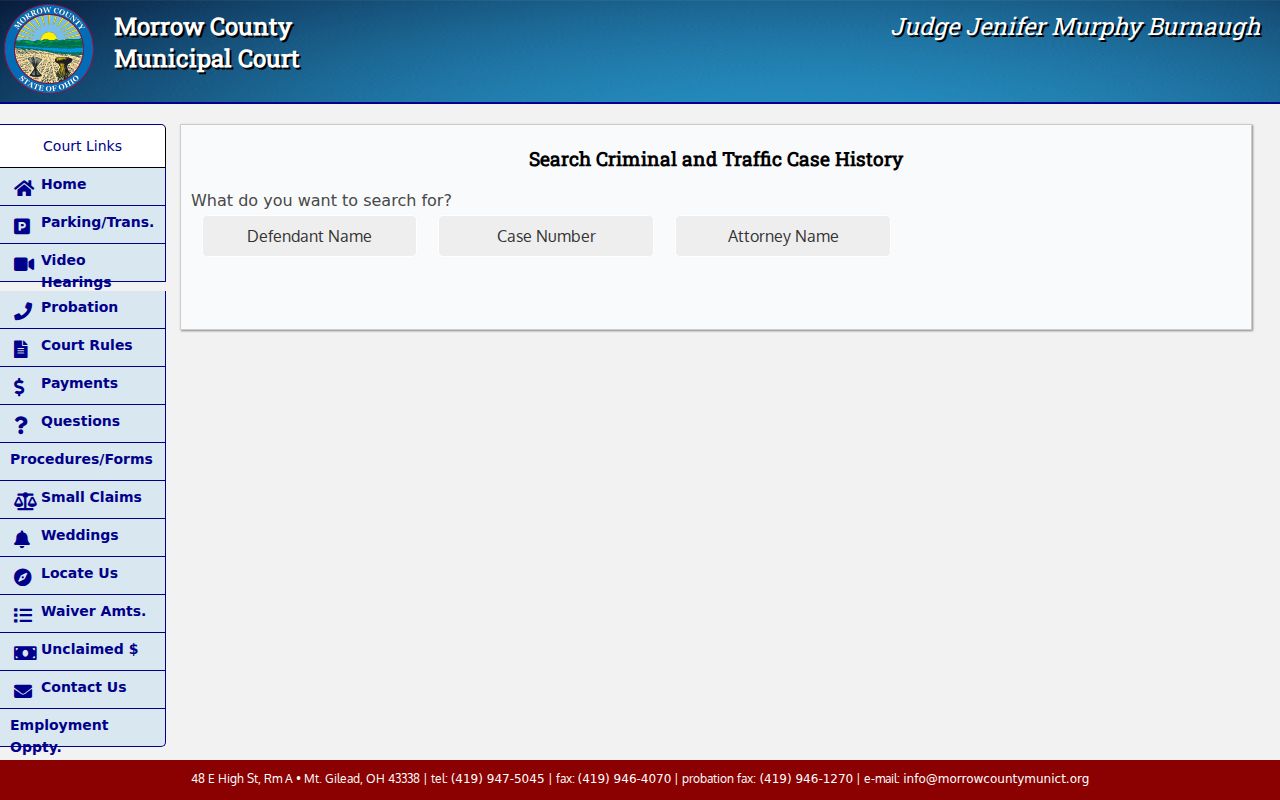
Those tabs help when a Municipal Court case exists. They work even if you lack the exact number. A name tab can narrow the field fast. The court's own disclaimer notes that its computerized records are public information. That information comes without a warranty. So when you need an official record, verify any docket result with the Municipal Clerk.
What a Criminal Docket Shows
A docket is not just a charge list. It is a chronological record the court itself maintains, entry by entry. Morrow County courts label their online routes differently. The Common Pleas clerk calls its route Case Inquiry. The Municipal Court uses Case History for its historical criminal search and Upcoming Hearings for its date-focused one. Because a complete online detail screen varies, the fields described here are the items a reader should look for and confirm in the live record. No two results display every field the same way.
| Case Number | The court-assigned identifier, such as the Municipal Court’s portal example 2005TRC1234. Check the displayed court and category before treating a prefix as conclusive. |
|---|---|
| Charge or Filing | The initiating allegation, indictment, information, or other filing event, with any public statute or offense description the court displays. |
| Hearing Settings | Current and prior arraignment, pretrial, trial, or other event dates. A past row may remain visible after a continuance. |
| Plea and Orders | A plea entry, motion, order, bond-related event, or other case action. Each needs to be read by date and in sequence. |
| Disposition | The current or final court outcome when shown. A charging entry, citation, or arrest record is not itself a final disposition. |
When you need an actual document or judgment entry, let the docket describe it first. Then ask the proper clerk for the record itself, including a certified copy if the situation calls for one.
Morrow Criminal Docket Terms
Read a label on a Morrow County criminal docket as a court-process marker. It is never a conclusion about the person or the case. The Municipal daily calendar has shown category families such as CR and TR. The search form gives a TRC-style example. No local code glossary is published. A prefix is a category clue. So confirm it against the actual court record before you rely on it.
- Arraignment
- An early criminal court stage where the charge is formally addressed and plea procedures occur. It is not a conviction.
- Pretrial
- A case-management hearing before trial that can concern readiness, motions, discovery, or possible resolution.
- Continuance
- A postponement of a scheduled event. The older setting can remain in the docket history after a later entry changes it.
- Disposition
- The recorded current or final case outcome. Read its date and any later compliance, appeal, or post-judgment entries.
If a calendar label and the case history disagree, trust the newest entry or call the court. A daily docket is one session's snapshot. It is not a lasting statement of where the case stands now.
Stages on a Criminal Docket
A Common Pleas criminal matter usually starts with a charge, indictment, or information. From there it moves through arraignment, release or bond events, and pretrial activity. Next comes a plea or trial. Then sentencing, disposition, and possibly appeal. Municipal criminal cases follow their own court record and schedule. The wording on a given Morrow County docket shifts with the court and the event. The sequence is what stays reliable, not any assumed abbreviation.
Docket flow: Charge Filed › Arraignment › Pretrial Settings › Plea or Trial › Disposition › Sentencing
A future setting is only a request to appear. It does not promise the case ends that day. Compare the current date, the case category, and the newest docket action before you plan travel or filings.
Morrow Criminal Hearing Dates
The Municipal Court's Upcoming Criminal and Traffic Hearings form adds an Upcoming Hearing Date field. That joins the usual name, case-number, and attorney routes. The court home page also posts date buttons for upcoming sessions. A daily results page can show a linked case number, court time, charge, and type. Still, it is a calendar slice. After a reset or a disposition, do not use it in place of the current case history.
Common Pleas settings run through the court's CourtView Calendar, its named Court Schedule channel. Local Rule 7 assigns scheduling of filed Common Pleas matters to the Assignment Commissioner. That work goes through CourtView Justice Solutions. If the portal session fails you, call the court office. Give the division, case number, and date to confirm the live setting.
Which Court Holds Criminal Dockets
Felony charges land in the Morrow County Court of Common Pleas General Division. Its criminal docket is the first place to look. The Morrow County Clerk of Courts, Common Pleas Legal Division, keeps that General Division docket. It also keeps the case files behind it. Misdemeanors and traffic work differently. Morrow County Municipal Court is a separate countywide court with its own computerized criminal and traffic records. Search both courts. A miss in one docket proves nothing about the other. The reverse holds just as true. The official General Division page names the court behind the felony docket route.
Municipal Court matters go through the Municipal Clerk's criminal/traffic forms. Some cases start even lower. Mount Gilead and Cardington both run Mayor's Courts. So a village contact may hold the original local record. A CourtView or Municipal search result is only a finding aid. It can locate a Morrow County criminal case, but it is not a certified disposition. For the real record, ask the clerk that holds the case. Name the court, division, case number, and document title. The posted Common Pleas schedule lists plain printed copies at $0.35 per page. Certified copies run $3.00. So confirm the full current charge for your request.
Morrow Criminal Court Origins
Where a Morrow County case started shapes where its docket sits. The Municipal Court contact directions say it plainly. A matter that began in Mount Gilead Mayor's Court or Cardington Mayor's Court requires notice to the appropriate village. A case can therefore carry a Mayor's Court origin. Later procedure may still bring it into Municipal Court. Read the court printed on the notice. That tells you which clerk holds the first docket. Mayor's Courts are their own local venues. A later municipal record does not change that. The originating court may still hold its own calendar, original disposition, or available copies. And no Morrow-wide portal stands in as a complete Mayor's Court criminal index.
Morrow Criminal Specialty Dockets
Morrow County Common Pleas runs a Substance Abuse Court. It holds four specialized dockets with adult, juvenile, and family or dependency treatment components. The adult track covers intervention-in-lieu, post-conviction, and post-release paths. That explains why a regular case record may show program activity, though it does not create a separate public criminal-search database. The county's Substance Abuse Court program page lays out the specialty-court structure.
The underlying case, if eligible, carries its program activity in the regular record. Access still turns on the division, court rules, sealing orders, and juvenile confidentiality rather than any special public calendar.
Public Access and Sealed Criminal Dockets
Open access has limits in Morrow County. Not every criminal record appears online, or in full. The Common Pleas online route depends on CourtView availability and the Ohio access rules. A docket can be missing for several reasons. Maybe the wrong court was searched, the online index is unavailable, the matter is restricted, or a Mayor's Court is the original holder. Juvenile records stay confidential except as Ohio law permits. A sealed conviction record must not be treated as an ordinary public search result.
Key Rules:
Ohio Revised Code § 2303.12 requires Common Pleas clerks to keep specified court records and governs electronic availability for qualifying General Division civil and criminal records.
Ohio Revised Code § 2953.32 sets the court-controlled process for an eligible person’s application to seal a conviction record.
Ohio Revised Code § 2151.14 makes juvenile-court records confidential except as Ohio law permits.
Never use a public search to get around a restriction. Ask the clerk what public version, if any, exists. Morrow County posts no portal code that reliably labels every sealed or restricted criminal docket. So do not assume any particular display term.